Fyndpuls
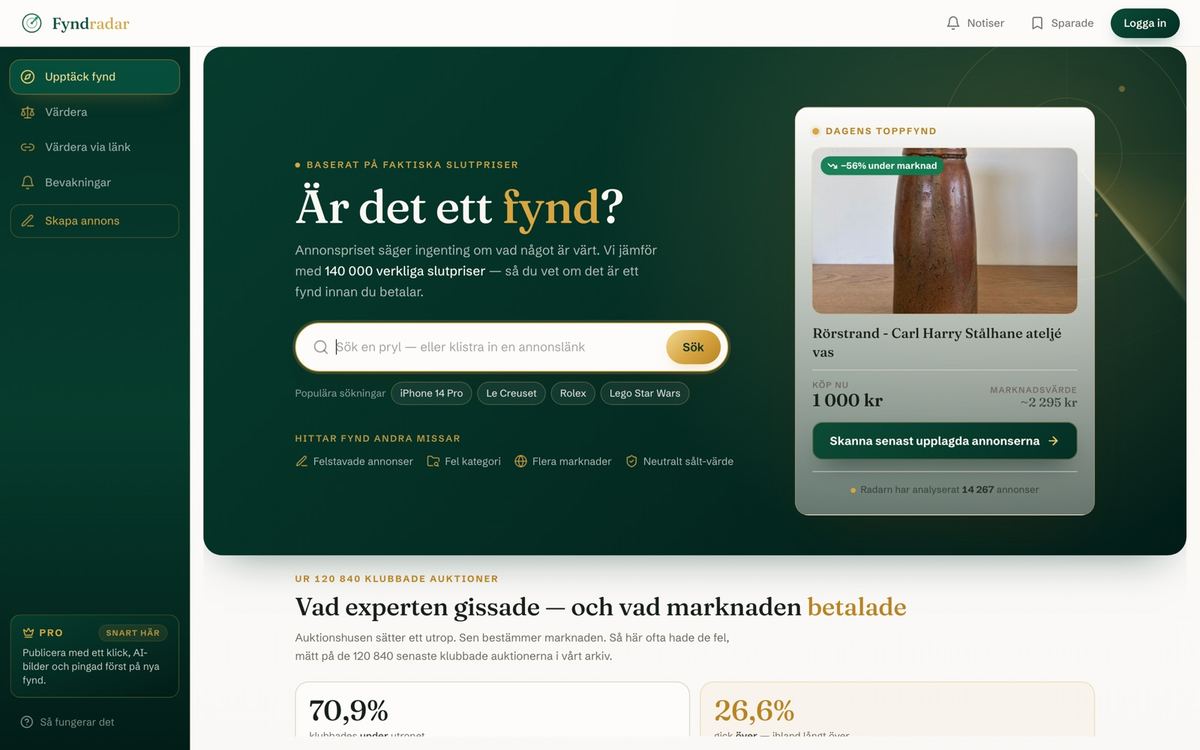
Fyndpuls answers the one question that matters before you buy: is this actually a good deal? It estimates an honest market value from 140,000 real sold prices across marketplaces and auctions, scores every listing, and surfaces the true finds before anyone else spots them.
- Year
- 2026
- Status
- Live
- Stack
 React
React Supabase
 Vercel
 Claude
 ChatGPT
 Lovable
- What I built
- I owned the product end to end, the concept, the value-check logic, the feed structure, and the AI prompts that classify and price each listing.

Background
The problem
Great second-hand deals disappear in minutes, and a listing's true value is buried across dozens of comparable sales. Checking several marketplaces by hand is slow and easy to miss.
The idea
One radar that continuously scans marketplaces and auctions, estimates a fair value for each item, and only surfaces the listings priced clearly below it.
How it works
- 01
Values come only from real final prices on Tradera and Auctionet, what things actually sold for, never what sellers hoped for. Asking prices are excluded on purpose.
- 02
A valuation needs at least three real sold comparables behind it. Below that the product says the basis is missing instead of showing a number.
- 03
Finds are graded rather than flagged once: ten percent under the comparable sold price counts as a find, twenty-five as a big one, forty as the top grade, and the email watch only fires at forty so an inbox stays worth opening.
- 04
When the comparables cover several variants, the result is shown as a range rather than an average that cannot be substantiated.
- 05
Reference bars in the market view each rest on at least 100 sold items, so the baseline is a real distribution and not a handful of outliers.
- 06
The rule the whole thing is built on: it does not guess. If the evidence is thin it says so, and shows the user the underlying listings to judge for themselves.
- Decision 1
Rank by deal strength, not just keywords, quality over volume.
- Decision 2
Two ways in to a valuation, a photograph or a pasted link, so the estimate is always one step away.
- Decision 3
Keep the human in the loop: the radar recommends, the user decides.
How I built it
- 01
Mapped what a 'real find' looks like and when an alert is actually worth sending.
- 02
Designed the core surfaces: browsing finds, valuing an item from a photograph, valuing one from a pasted listing link, and standing watches.
- 03
Built the valuation rules on real sold prices, with a minimum evidence bar before any number is shown.
- 04
Built a clean feed where the strongest finds rise to the top.
What came of it
What I learned
- Trustworthy pricing is the whole product, one wrong estimate breaks confidence.
- Fewer, higher-confidence alerts beat a noisy firehose.
Next steps
- Saved searches and category-specific value models.
- Push/email alerts with a confidence score.
Business potential
Resellers and bargain hunters are a motivated, recurring audience. Clear path to freemium (limited alerts) and pro (more categories, faster refresh, analytics).
Happy to walk through the thinking, the trade-offs and where it's headed next.
Get in touch